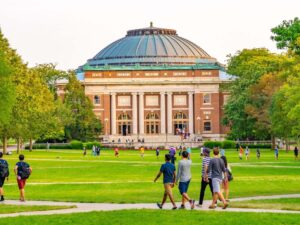

Q&A with BT: How Students Can Make The Most of College Visits
College visits can be as daunting as they are exciting. Spending time on campus can reveal that a school that…

By Christopher Rim | June 11, 2026, 10:32am EDT
It is a common misconception that colleges only care about the academic endeavors that students undertake during the summer months. Many students assume that if they aren’t attending a prestigious summer program, taking a rigorous summer class, or conducting a flashy internship in their field of interest, their summer activities aren’t worthy of the Activities List. Do top colleges really care about a summer job scooping ice cream?
It may surprise many students to learn that the answer to this question is an emphatic yes. A summer job can demonstrate a student’s responsibility, communication skills, and self-motivation to colleges—and, most importantly, when students approach it with curiosity and intention, a summer job can be a laboratory for cultivating important skills that will carry students through the next phase of their academic and professional lives.
According to research from the Georgetown University Center on Education and the Workforce (CEW), five cognitive competencies are in high demand across virtually every occupational group in the modern labor market: communication, teamwork, sales and customer service, leadership, and problem solving and complex thinking. These aren’t skills reserved for the boardroom or the college seminar. Ambitious students can begin cultivating these core competencies this summer, no matter what type of work they choose to pursue.
In recent months, experts have raised concerns about young people’s eroding communication skills, as widespread use of AI and social media and the lingering effects of Covid lockdowns have stunted students’ abilities to express themselves in both written and verbal communication. The consequences are showing up in classrooms, on college campuses, and increasingly in entry-level workplaces, where managers report that young hires struggle with everything from making eye contact during a conversation to composing a coherent professional email.
Combatting these issues requires practice in a range of different contexts, in and outside of the classroom. When a high schooler has to interact with an impatient customer, resolve a scheduling conflict with a manager, or write a professional email for the first time, they are developing the ability to communicate clearly and confidently under real-world pressure.
Collaboration is one of the most universally valued skills in the workforce, and it’s also one of the hardest to teach in a traditional academic setting. Group projects in school have grades as the stakes. In a workplace, the stakes are more tangible: coworkers are depending on you, customers are waiting, and managers have a high standard for success.
A summer job teaches students that teamwork isn’t about getting along with people they like—it’s about showing up reliably for people they may have just met, with different backgrounds, work styles, and priorities than their own. It presents a unique opportunity for high school students to collaborate across differences and build relationships with people who are different from themselves. Students who actively invest in their coworker relationships, step in when a teammate is overwhelmed, and approach shared goals with a sense of collective ownership will grow into more reliable and productive team members in their future careers.
Every job, to varying degrees, involves customer service. In whatever role they occupy, students working a summer job reflect the brand they work for. Those who choose to take this seriously and model professionalism in all of their interactions will differentiate themselves early on to both customers and managers.
Beyond the transactional, customer service work builds empathy and emotional resilience. Handling a difficult customer gracefully, recovering from a mistake in front of a client, and learning to separate personal feelings from professional responsibility are lessons that take years to develop in some careers. Students who are thrown into these situations at sixteen or seventeen arrive at college and eventually the workforce with advanced emotional fluency and the ability to convey professionalism across a range of contexts.
Students should remember that leadership doesn’t always require a formal title—a summer job offers myriad opportunities for students to step up and practice their leadership skills in the workplace. Students who take initiative, mentor newer hires, or suggest a better way to handle a recurring problem are discovering and refining their leadership skills, often without thinking about it. While students aren’t always in a position to return to the same summer job numerous years in a row or continue working during the school year, returning to the same place of work may allow students to grow into more formal leadership roles over time.
Admissions officers at top universities aren’t only looking for students who hold the title of captain or president. They’re looking for evidence of agency, initiative, and the ability to influence others positively, even when no one is watching. A summer job is a concrete, credibility-building environment to do exactly that. Students should document these moments and reflect on what they learned from them—these reflections can be invaluable for writing the personal statement and supplemental essays when the time comes.
Like communication, complex thinking is a skill that has seen a decline amongst high school students in the age of digital communication. However, it is one of the most essential skills for students to thrive in college, where they will have to build autonomy and juggle new responsibilities and challenges with adaptability and creative thinking. A summer job is an ideal opportunity to practice staying calm under pressure and innovating solutions to real-world problems.
Problem solving in a professional context also means knowing when to ask for help—a skill that requires both self-awareness and humility. Understanding when and where to ask for help will set students up for success in the next phase of their learning journey.
A summer job may seem like a means to an end; for many students, it represents an opportunity to earn more money, fill their free time, or add a line on their resume. But the students who will get the most out of it are those who see summer work as a dynamic space to learn and grow. For those students, summer work can yield standout letters of recommendation, memorable college essays, and the skills they need to thrive in the years ahead.
Originally published on Forbes on June 11, 2026